About 600 years before Christ, Zoroaster was born, the person who attempted and largely succeeded in eliminating polytheistic religions.
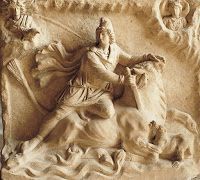
Zoroaster preached of a single god, ORMUZ, and he had a favorite son, Mithra, who was born on December 25th in a cave and was worshipped by shepherds who brought him gifts, accompanied by 6 guardian spirits.
This Iranian sage preached the duality between good and evil, light and darkness, decisively influencing the Jewish religion, and by doing so in the Jewish faith, he imbued this philosophy into Christianity and Islam. We could say that the idea of a god divided between good and evil as we know it stems from his philosophy. Every time we think that the forces of good are in struggle with the forces of evil, we are preaching the truth of this well-known figure.
However, one only needs to travel through Andalusia or any other region with Roman ancestors and on the peninsula with Celtic influence to verify that polytheism is still very much in effect. We have the saint of rain, the one of drivers, the one of medicine, the Virgin of this or that, etc. etc. etc., it is merely a disguise of religious polytheism. Possibly the religious unification into a single god that granted all power to a single element, be it Ormuz, Mithra, Ahura Mazda or simply the sun god or Jesus, was the prelude to the intention of unifying everything under a single rule, and it was and is the symbol of royalty, which acts like the sun exercising authority over everything that happens around it.
It is not surprising then that monotheistic religions were received with jubilation by emperors and powerful figures. Once the people have accepted the idea of a single divine power, it is easier to exercise unilateral psychological and material control also in the earthly realm. However, there are positive implications in monotheistic religions: unification, everyone looking at the same point of light and seeing a single truth, is a way of grouping and balancing tendencies that are often lost.
 |
| MITRA EN ASTROES.COM |
We are all very similar and belong to the same species. What happens with Zoroaster is that he exercises a strict duality, and between good and evil there can be a path, and in this case as in the vast majority of what reaches us from ancient tradition, the inspired message at the beginning loses meaning when it is filtered through the interests of a society and a government with «less heavenly interests».
To summarize my opinion on the influence of Zoroaster and his philosophy, I would say that fear of hell and malignant powers required a strong projection toward good and good values, and in this way society was polarized between the good and the bad, those who would face hell and those who would be by the side of Ormuz. This religion already preached resurrection, and in this way, following the thread of Judaism and Christianity, it reaches our days, in which in that part of the world, and even in the United States, the "axis of evil" continues to exist. Glory to Mithra.