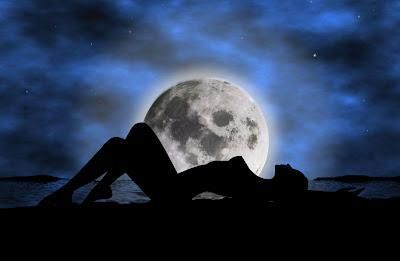
Full Moon and Empty Statistics
The full moon has always been a source of fascination and not only for horoscopes or astrology, and statistics, through it primitive humans had the need and sensation of being connected with the rest of the cosmos, a way to do it was by using our senses and I cannot imagine a more natural way of feeling the connection with the universe than through the sun and the moon, the Sun radiates light and heat that communicates with all of nature, and the Moon is the closest celestial body and the one that brings us closer to the outside of the earth, seeing the moon we see something distant but at the same time familiar, this peculiar characteristic evoked when it was full the sensation of being able to be used to communicate with supernatural beings.
It is easy to put ourselves in the place of our ancestors spending a night of full moon in a place without light pollution, you can also feel its "magic" more clearly in nature.
The popular belief that the moon influences births, mood, and people of especially sensitive nature, is something universal in any corner of the world, many studies have been conducted in this regard, however like the moon they are very fluctuating, there are some that clearly detail an effect on mood, others conclude a statistical equality.
However all studies in relation to statistics depend on how they are carried out, even the most skeptical about mood have to admit that there is clear evidence of lunar influence over certain behaviors, although in many cases they are behaviors and unexpected circumstances that become apparent when conducting these studies.
As examples let us take: That the influence of the moon on the appearance of coronary events has been studied. Researchers at Apollo Hospital, in Chennai, India, noted an increase in admissions on days of full moon for heart pain; they also detected variations in blood pressure of patients and in the appearance of anginas.
Cuts of timber trees should always be made during the waning moon, if not done so the wood shortly after is prey to pests that end up destroying it, and if not ask a professional, however what would science say about the gravitational influence of the moon on a tiny tree?
Human beings have been on this planet for 2 million years, we can still find tribes that try to live with the cycles of nature, we can imagine a time when only the lights of the stars existed in the darkness, the lights of the planets and the light of the moon.
During the day only the light of the sun, and later once fire was discovered humans learned to obtain their own light. Necessarily a natural cycle had to be followed, nothing of living at night and sleeping during the day, in this way and taking into account that however slow it is there is an evolution, the human being has been adapting its nature and its biological rhythms to natural conditions, conditions that have prevailed for much longer than those of the industrial era.
It is known for example that differences in size, in the color of skin and hair, eye color etc. etc., are adaptations to a natural environment that has nothing to do with the current one.
If bronzers had always existed probably people of color would not exist, if sunglasses had always existed surely we would all have the same eye color or at least similar, human beings have been adapting their biology based on external needs, and it is logical to suppose that they adapted their body to the cycles of nature.
The full moon has always fulfilled a regular cycle, possibly one of the most predictable elements that the human race has encountered since the beginning along with the sun, it also seems easy for me to imagine that the moon would be used as a clock that would mark the time elapsed and the time that remained for another event to occur.
Thus a pregnancy was possibly measured with a time of nine moons, and the time of birth by the closest moon.
For astrology there is no moon in which more births occur, however if there exists depending on the moment of conception more possibilities that the birth will occur on a certain date.
It is clear that knowing the moment of conception is something very difficult, perhaps that is why astrology takes as a reference the moment of birth, although I know that was not always the case.
When a statistical market study says that the moon has no effect on mood, in reality it is only taking into account an objective effect, the genetic memory of our species is very related to the cycles of the moon, however at many levels difficult to quantify and easily recognizable in a subjective way.
If we were to conduct a study of a statistical nature on the effect of a spring day on mood after five dark and rainy days, it would not yield any results either, in the same way ask yourselves what result would a statistical study on the satisfaction of watching a sunset at the Alhambra and its effect on morphology yield.
This fact which would be objective at a scientific level would cease to be stupidity for the rest of the world, there are still many steps to take at a scientific level to find certain answers that will surely be found, meanwhile more than 90% of the people you consult with you will observe that they know their zodiac sign, something that especially irritates the type of people who conduct statistical studies on how astrology works or any subject in which subjectivity is so valued.
I would like this to be analyzed: Are subjective knowledge hereditary?, it is known that there is a genetic predisposition to a certain way of thinking, for example to be more conservative or less, therefore the different ways of approaching the same issue can be nuanced and surely will be always.
If we conduct a study on whether conservative thinking is better, for part of the characters studied there will be no doubts that yes, for another there will be no doubts that no, and statistics will only be used to satisfy one and the other demands.
|
THE EFFECT OF THE FULL MOON |
Science acts in a similar way when facing irrefutable truths, such as that in any place and time in history and prehistory Astrology and the influence of the Moon are valued differently than what statistics reflect, science acts in some occasions like the old Hindu saying about three people who touched an elephant, and one insisted on saying it was long and thin, another that it was broad and flat and another that it was hard and pointed like sharp ivory drawing conclusions that do not take into account a totality, possibly we lack some data to fill this puzzle.