SOLAR ECLIPSEThere are four types of solar eclipse:
* Partial: the Moon does not completely cover the solar disk which appears as a crescent.
* Partial Annular: the Moon almost completely covers the Sun, but does not succeed.
* Total: from a band (band of totality) on the Earth's surface, the Moon completely covers the Sun.[1] Outside the band of totality the eclipse is partial. A total eclipse will be seen by observers on Earth who are within the cone of the lunar shadow, whose maximum diameter on our planet's surface will not exceed 270 km, and which moves in an easterly direction at about 3,200 km/h. The duration of the totality phase can last several minutes, between 2 and 7.5, with the entire phenomenon lasting just over 2 hours, although in annular eclipses the maximum duration reaches 12 minutes and exceeds 4 hours in partial eclipses, with this zone of totality having a maximum width of 272 km and a maximum length of 15,000 km.
* Annular: occurs when the Moon is near apogee and its angular diameter is smaller than the Sun's, so that during the maximum phase a ring of the Sun's disk remains visible. This occurs in the band of annularity; outside of it the eclipse is partial.
For a solar eclipse to occur, the Moon must be at or near one of its nodes, and have the same celestial longitude as the Sun.
 Each year without fail two solar eclipses occur near the nodes of the lunar orbit, although four or even five eclipses can occur. Five solar eclipses occur in a year when the first of them takes place shortly after January 1st. Then the second will take place at the next new moon, the third and fourth will occur before six months have passed, and the fifth will take place 345 days after the first, since that is the number of days contained in 12 synodic months.
On average, a total solar eclipse occurs at the same point on Earth once every 200-300 years. For a solar eclipse to occur, the Moon must be in inferior conjunction (new moon) and also the Sun must be between 18º 31´ and 15º 21´ of one of the nodes of the lunar orbit.
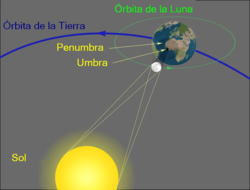
Geometry of a total solar eclipse.